October 2026 Dark Web Breach Incident Trend Report
Note
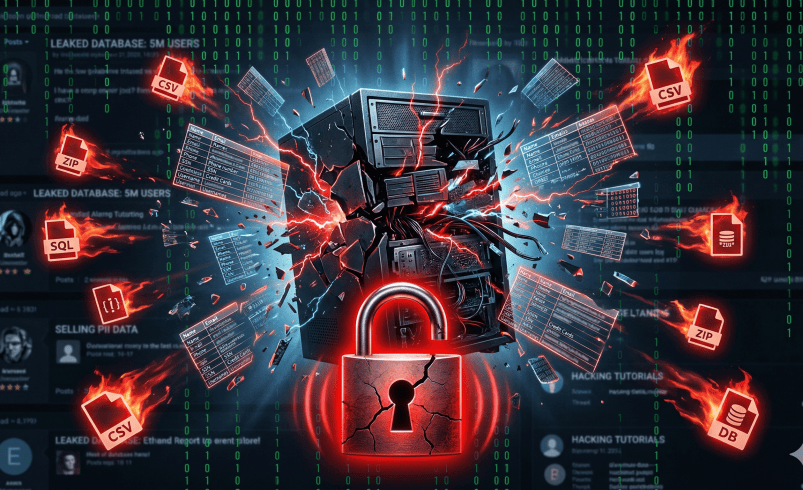
In October 2026, widespread instances of database leaks, the sale of accounts and credentials, and the disclosure of source code were observed on dark web and deep web forums. The government, public sector, defense, finance, healthcare, telecommunications, distribution, Education sector, manufacturing, energy, and IT sectors were the primary targets; however, due to the nature of the sources, it was difficult to fully verify the accuracy of some posts.
Major Issue
- In the government and public sectors, it was confirmed that the personal information of more than 41,000 employees of US government agencies had been exposed. An organization involved in international cooperation and peace claimed to have obtained the data through a single sign-on service, but the service provider stated there was no evidence of a breach.
- Across Latin America, Asia, the Middle East, and Europe, personal information, internal documents, and administrative access privileges from public institutions and government agencies were also traded or shared. Examples include naval and defense agencies, social security agencies, law enforcement agencies, national parliaments, single sign-on (SSO) systems of African regional governments, and access privileges to VPNs and web management systems of local governments in Southeast Asia.
- In the defense and aerospace sectors, approximately 1.5 TB of documents from defense R&D agencies, 1.2 TB of documents from nuclear regulatory agencies, internal technical documents related to defense satellite projects from private space companies, and internal data from defense and aviation service companies were sold or shared.
- In the financial sector, customer data, transaction data, internal system data, and administrator access credentials from numerous companies—including banks, digital asset service providers, financial SaaS companies, insurance companies, and fintech firms—were identified. Additionally, there were claims of large-scale data breaches at global investment banks, e-commerce companies, and telecommunications companies, although some of these claims were denied by the companies involved.
- In the healthcare and pharmaceutical sector, claims of data breaches involving internal confidential and research data, employee information, patient records, and account data from global pharmaceutical companies, medical distribution firms, hearing aid manufacturers, national hospitals, and healthcare service providers were posted. For some posts, it was difficult to verify whether they represented new breaches, as the data may have been repurposed from publicly available sources.
- In the telecommunications, retail, and consumer services sectors, customer, account, and internal data from e-commerce platforms, telecommunications companies, secondhand trading platforms, energy companies, telecommunications companies, major bookstores and retailers, food distributors, online communities, mobile service providers, and educational platforms were posted. Some appeared to be reposts of previously leaked data, while in other cases, the companies denied that a breach had occurred.
- The sale of initial access credentials also continued. Access to electronic billing portals of logistics and transportation companies, VPNs of global logistics firms, various cloud environments and databases, virtualization infrastructure, administrator pages, and FTP access were traded. Such credentials can be exploited as a preliminary step in ransomware attacks and data exfiltration.
- Leaks of source code and internal development materials also continued. Confirmed examples included source code and access credentials for the internal computing infrastructure of a generative AI company; source code for the internal portal of a European telecommunications company; source code and Access to database backups from an IT services company; repository data from an AI data company; internal source code from a global IT services company; and a private repository from a logistics software company.
- AI-related transactions have recently become more prominent. Observations included claims of selling large language model (LLM) weights, claims of selling user information and API keys from AI API platforms, the solicitation of logs containing AWS and AI service API keys, and the sharing of prompts designed to bypass generative AI services. However, some of these claims have not been officially confirmed.
- In South Korea, data sales posts targeting companies and institutions in the telecommunications, movie theater, health and beauty, Education sector, secondhand marketplace, and logistics sectors were observed. Many of these posts had low reputation scores within the forums, indicating low credibility, and data related to military counterintelligence agencies was confirmed to be reposts of older content.
- In South Korea, materials related to military unmanned aerial vehicle (UAV) projects, data on faculty and staff as well as recruitment at cyber universities, access to production facility systems at domestic steel pipe manufacturers, and customer data and endpoint access privileges at overseas automotive sales subsidiaries were also observed.
- Some threat actors claimed to have demanded money from a global payment service provider, but whether a breach actually occurred has not been independently verified. Additionally, cases were identified where automotive parts distributors and medical device companies were listed as victims, though some of these posts were later deleted.
Conclusion
The October 2026 dark web breach trends can be summarized as a month marked by continued claims of large-scale data leaks and the trading of accounts and access privileges across the government, defense, finance, healthcare, telecommunications, retail, and AI sectors. However, since a significant number of posts were found to involve corporate denials, reposts of old data, low credibility, or a lack of official verification, the actual scale of breaches must be distinguished from the claimed figures when interpreting the data.
With regard to AI services, transactions that target generative AI companies and AI platforms have been identified, and API keys, source code, and administrator privileges pose a high risk of leading to subsequent breaches. Furthermore, posts claiming to disclose information on US government agency employees, trading defense and aerospace-related materials, and selling large-scale datasets from the finance and telecommunications sectors demonstrate that supply chain security risks persist across the region and across industries.