August 2026 Dark Web Breach Incident Trend Report

Note
In August 2026, widespread instances of database leaks, the sale of internal data, and the trading of initial access privileges were observed on dark web and deep web forums. Due to the nature of the sources, it was difficult to fully verify the accuracy of some posts.
Major Issues
- ShinyHunters continued to make claims of consecutive data breaches and issue public threats against numerous organizations, including a US data center operator, a live streaming platform, a digital healthcare company, an open-source analytics platform, a global medical device company, and a French intellectual property services firm. Evidence was also found that the group exploited the .Claims top-level domain against certain streaming platforms.
- In the government and public institution sector, numerous claims of personal information and internal data leaks were confirmed involving national-level agencies, such as a Brazilian government IT service agency, a French education administration agency, an Argentine identity management agency, an electoral management agency in the Dominican Republic, and a Chinese law enforcement agency. However, the figures regarding large-scale data breaches involving Brazilian government agencies and educational institutions in France are based solely on the threat actors’ claims and have not been officially verified.
- In the financial services sector, data and account information related to a Chinese payment network company, a Chinese electronic payment platform, a state-owned bank in Iran, an Indian digital payment service provider, a Chinese insurance company, a state-owned bank in Qatar, a commercial bank in the UAE, a virtual asset wallet service provider, and a hardware wallet manufacturer were circulated.
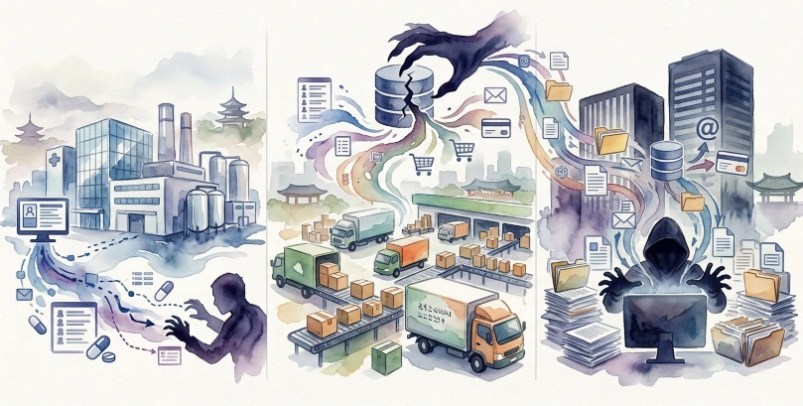
- In Korea, 1 TB of data from the internal file servers of a domestic asset management firm, approximately 47.96 Million records of customer, delivery driver, and franchisee data from a domestic logistics platform, approximately 1.28 Million records of personal information of members of a domestic religious organization, internal data from two domestic manufacturers, approximately 637 GB of internal data from a Korean industrial automation company, and the sale of administrator and root access credentials for 2,980 NVR devices.
- Regarding approximately 48 million posts related to a Korea-based public health insurance institution, it could not be confirmed whether an actual data breach occurred due to suspicions of sample manipulation and the institution’s denial. The 33 million data records related to a Korea-based e-commerce platform were confirmed to be fabricated, and data on Korea-based online travel and lodging platform brands was also determined to have low credibility.
- Personal information of members of religious organizations in Korea was continuously circulated on various forums, complete with detailed field structures, and was assessed as a relatively credible case. A trend linking this to a similar case in April 2026 was also confirmed.
- In Saudi Arabia, data breaches were observed intensively across a wide range of government and private platforms, including logistics and transportation companies, digital service platforms, IPTV services, region-specific service providers, IT service companies, and hotel operators.
- In addition, data breaches involving public and private sectors and the trading of account information continued in various regions, including Japan, China, India, France, the United Kingdom, the US, Argentina, Bolivia, and the Philippines.
- Evidence was also found that enterprise administrator privileges for virtualization and remote access management solutions used by technology and SaaS companies in the Region of Sweden were being sold on cybercrime forums.
Conclusion
August 2026 was a month marked by specific threat actors’ continuous targeting of multinational corporations and claims of large-scale data breaches against government agencies and public institutions. In South Korea, indications of data breaches were observed across the financial, retail, manufacturing, religious, and travel/platform sectors; however, some posts were confirmed to contain false or low-credibility data. Therefore, organizations and companies must individually cross-verify the authenticity of dark web posts and assess the possibility of new breaches, and continuous monitoring is required regarding the trading of high-risk access privileges, such as administrator privileges.